Skip to Content

The Airport Master Plan

Planning, Safety and a Forward-Looking Vision for Island Airports

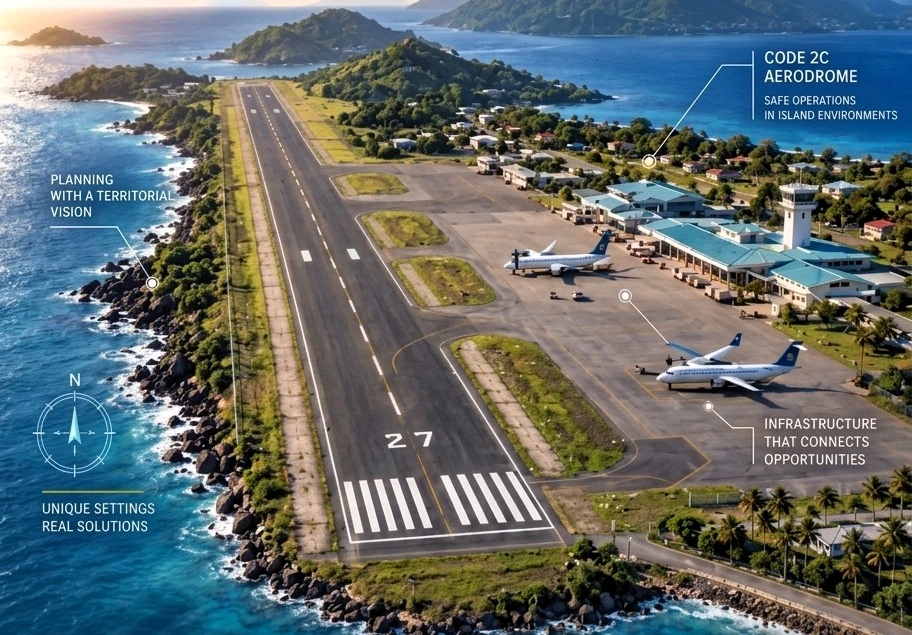
Airport Master Plan infographic showing aerial view of runway and terminal in an island environment

By. L. Pérez Pérez Eng. MSc.

President, Perez Engineering Consulting Services Ltd

Download

Presentation


An airport should not grow through isolated works or improvised responses to urgent needs. Its development must respond to a technical, institutional and economic vision capable of organizing investments, protecting operational safety, anticipating risks and preserving future opportunities.
The Airport Master Plan is the tool that transforms that vision into a development route. It does not require everything to be built immediately, does not replace the civil aviation authority and does not certify an aerodrome by itself. Its value lies in ordering decisions, prioritizing investments, protecting strategic areas and preparing the airport to grow with greater safety, efficiency and sustainability.
In Small Island States, where land is limited, financial resources must be carefully managed and expansion can be constrained by the sea, topography, nearby communities or the environment, master planning is not a technical luxury. It is a strategic necessity.
This executive brief introduces the main ideas of the full technical publication and directs readers to the complete PDF, where the arguments are developed in greater detail.
CENTRAL IDEA
An Airport Master Plan is not a list of works. It is a strategy for deciding what to build, when to build it, where to locate it and how to protect the airport’s future.
1. Why an airport needs a Master Plan?


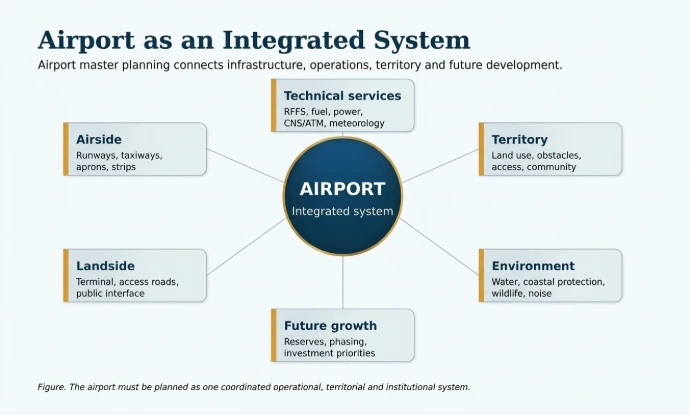
An airport is not an isolated infrastructure or a simple combination of runway, terminal and apron. It is a system where airside, landside, technical services, operational safety, territorial context, environment, demand, aircraft, investments and institutional decisions interact.
When these components grow without coordination, the airport may accumulate individually useful works that are incoherent as a system. The Master Plan helps avoid these contradictions by identifying priorities, protecting land, organizing investments, coordinating actors, anticipating risks and establishing a reasonable development sequence.
For small and island airports, the need is even greater. Limited space, economic constraints, climate exposure and dependence on air connectivity mean that every decision has long-term consequences.
MESSAGE FOR SMALL ISLAND STATES
The more constrained an airport is, the more important it becomes to plan it correctly. Where there are no large land reserves or resources to correct costly mistakes, every decision must protect the future.


2. What an Airport Master Plan integrates


Diagram of the airport as an integrated system connecting airside, landside, technical services, territory, environment, and future growth
An Airport Master Plan integrates diagnosis, demand, capacity, operational safety, land use, investments, resilience, sustainability and preparation for future certification processes. It translates the airport’s present reality and future needs into an organized development strategy.

3. Opera onal safety, demand and capacity


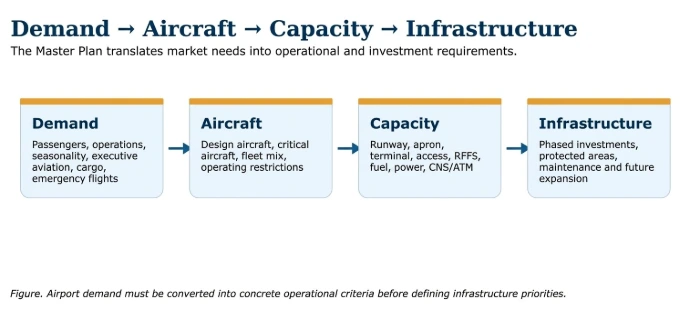
Master Plan process flow chart translating Demand into Aircraft, Capacity, and Infrastructure requirements

Operational safety must remain at the center of airport development. Identifying risks does not mean stopping growth; it provides a stronger basis for justifying investments and improving the airport’s real operating conditions.

Demand is not measured only in passengers. It must be translated into aircraft types, operations, peak periods, apron positions, ramp services, terminal flows, access roads, fuel, energy, emergency services, communications, visual aids and support infrastructure.

The airport is only as strong as its limiting component. A runway may be adequate while the apron, terminal, access road, fuel system, electrical system or emergency services remain the true bottleneck.

4. Infrastructure and phased development


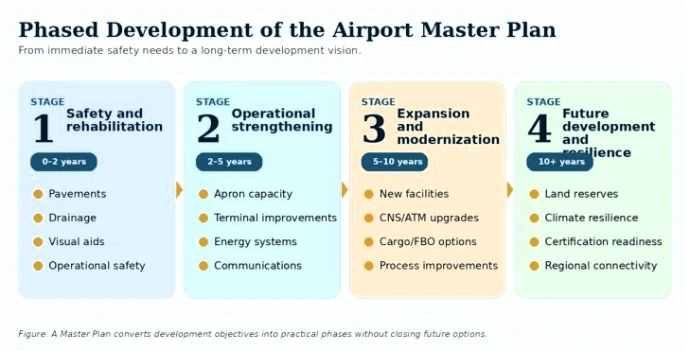
Airport infrastructure planning framework and short, medium, and long-term phased development stages

Planning does not mean building everything immediately. It means knowing what must come first, what can wait, what must be protected and which decisions today should not block future solutions.

A project portfolio organized by stages helps present short-, medium- and long-term priorities, prepare progressive financing and ensure that each phase adds value without blocking future development.

5. Resilience, Energy and Certification Readiness


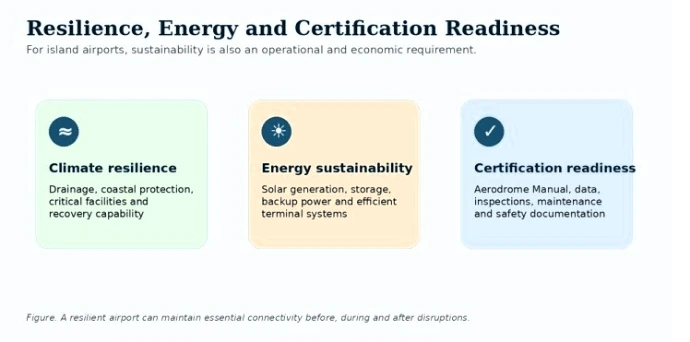
Airport master planning diagram for climate resilience, clean energy integration, and aerodrome certification readiness

For island airports, environment, climate and energy are not secondary matters. They are strategic conditions for maintaining connectivity, protecting investments and ensuring operational continuity.

Solar energy, drainage, coastal protection, backup power, emergency access, critical facilities and recovery capacity should be part of the master planning process.

The Master Plan does not certify an aerodrome, but it can create the technical, documentary and institutional basis for moving toward Aerodrome Certification.

6. Governance, financing and Caribbean lessons


The Master Plan needs State leadership, operator knowledge, regulatory oversight and specialized technical advice. Its value increases when it becomes a common reference for governments, airport operators, civil aviation authorities, financing institutions and investors.

For Caribbean island airports, the main lesson is clear: physical limitation is not impossibility. With serious, realistic and progressive planning, an island airport can improve safety, strengthen resilience, protect its future and contribute decisively to national development.

7. Full publica on and PECS technical support

This executive brief refers to the full technical publication in PDF, where the arguments on airport master planning, operational safety, demand, infrastructure, resilience, certification readiness, governance and financing are developed in greater detail.
Perez Engineering Consulting Services Ltd. supports public administrations, airport operators and aviation stakeholders in preparing studies, plans, designs and technical evaluations aimed at modernizing airport infrastructure with safety, sustainability and a long-term vision.


This publication is part of Perez Engineering Consulting Services Ltd.’s Technical Insight Series, which shares practical knowledge and expert perspectives on airport planning, infrastructure, safety, and resilient development for island territories. Our goal is to support informed decision-making and stronger, more connected communities through sustainable aviation infrastructure.