
Operational Safety and Airport Development in Island States
Aerodrome Reference Code, Design Aircraft and ACR-PCR Method as tools for planning - not for limiting - the orderly modernization of airport infrastructure.
Keywords: operational safety, insular aerodromes, ICAO Aerodrome Reference Code, Critical Aircraft, ACR-PCR, airport pavements, phased planning.
1. Introduction: standards to guide, not to halt development
International aviation standards were not conceived to immobilize development, but to guide it with safety, transparency and proportionality.
Airport development requires more than the mechanical application of tables, codes and classifications. It requires the correct interpretation of standards, an understanding of the real scope of each technical concept, and an evaluation of the physical, operational, economic and regulatory conditions of the specific aerodrome.
In modern airport planning, terms such as Aerodrome Reference Code, Design Aircraft, Critical Aircraft, declared distances, pavement strength, ACN-PCN or ACR-PCR should not be used in isolation or as absolute arguments. Each belongs to a specific part of the analysis and only acquires its proper meaning when integrated into a complete operational safety assessment.
This precision is particularly important at small, regional or insular airports, where opportunities for expansion may be conditioned by geography, coastline, topography, urbanized areas, land availability and the economic capacity of the State or local administration.
In such contexts, operational safety is not always achieved through an immediate transformation toward an ideal configuration. It is often achieved through progressive processes of investment, risk mitigation, regulatory oversight, land-use safeguarding and long-term planning.
2. The Aerodrome Reference Code: a planning tool.
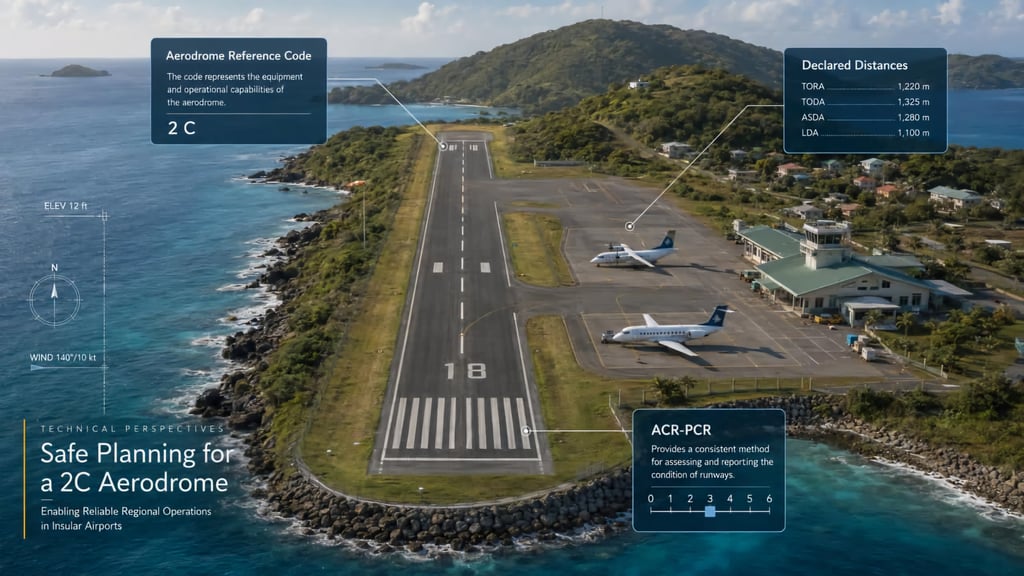
The Aerodrome Reference Code established by the International Civil Aviation Organization is a tool intended to relate certain aircraft characteristics to the physical design criteria of aerodromes. Its main purpose is to support the planning of facilities such as runways, taxiways, strips, shoulders, aprons, separations, safety areas and other airside components.
This code consists of two elements. The first is a number associated with the aircraft reference field length. The second is a letter mainly associated with geometric characteristics such as wingspan and outer main gear wheel span.
A frequent and technically incomplete interpretation is to assume that the Aerodrome Reference Code automatically determines the required runway length, pavement strength or operational authorization for a given aircraft. Such a reading unduly simplifies the purpose of the system.
The actual runway length required for an operation depends on additional factors: aircraft weight, temperature, elevation, runway slope, wind, surface condition, obstacles, departure and arrival procedures, required fuel, alternate aerodromes, regulatory margins and the airline’s operational policies.
Therefore, the Aerodrome Reference Code does not replace aircraft performance studies or the decisions of the competent aeronautical authority. Nor should it be used as an automatic argument to prevent progressive improvements at an existing aerodrome.
3. Design Aircraft, Critical Aircraft and aircraft family
The selection of a reference aircraft is a normal practice in airport planning. Such an aircraft may be used to assess geometric dimensions, turning radii, runway strips, separations, aprons, pavements, visual aids, procedures and operational compatibility.
However, a clear distinction must be made between using an aircraft as a technical reference and formally declaring that the aerodrome is changing its operational category. An aircraft may be used for compatibility analysis, future planning, evaluation of restrictions or comparative studies without necessarily implying regular, unrestricted and full operations at all possible weights and conditions.
The FAA uses the concept of critical aircraft to support airport planning and design studies. This determination is not based on the mere mention of an aircraft in a document, but on its operational relevance, regular or forecast use, and its ability to in5uence specific elements of the infrastructure.
For pavements, the logic is even broader. The structure should not be evaluated solely on the basis of one isolated aircraft, but by considering a representative family or mix of aircraft: those currently operating, those that may reasonably operate in the future, their operating weights, landing gear configurations, tire pressures, movement frequencies and cumulative e6ects on the pavement.
4. What the Aerodrome Reference Code does not determine by itself
One of the major sources of confusion in airport analysis is to attribute functions to the Aerodrome Reference Code that do not belong to it.
The Aerodrome Reference Code does not, by itself, determine the physical runway length. Nor does it define, in isolation, the structural strength of the pavement. It does not constitute an automatic operational authorization for a specific aircraft. It does not replace obstacle studies. It does not substitute the aircraft performance analysis carried out by operators. It does not eliminate the need to assess declared distances, meteorological conditions, procedures, visual aids, emergency services and operational restrictions.
This distinction is particularly relevant when considering the possible operation of higher-performance aircraft at existing aerodromes with physical constraints. An aircraft may fall within a given reference category and yet operate only under specific restrictions related to weight, frequency, meteorology, time of operation, fuel or commercial payload.
The correct technical question is not simply whether an aircraft belongs to a higher category. The correct question is under what physical, operational, structural and regulatory conditions a safe operation can be authorized, and what investments would be required to gradually expand those conditions in the future.
5. From ACN-PCN to the ACR-PCR Method: a new logic for airport pavements
Airport pavement should not be understood as the result of a single isolated design aircraft, but as the structural response to a realistic mix of current and forecast traffic.
For decades, the ACN-PCN method was the internationally used system to express compatibility between aircraft and airport pavement strength. In general terms, the ACN indicated the relative effect of an aircraft on a given pavement, while the PCN represented the reported bearing capacity of the pavement.
The transition to the ACR-PCR Method represents an important technical evolution. The ACR, or Aircraft Classification Rating, expresses the aircraft classification. The PCR, or Pavement Classification Rating, expresses the pavement classification. Both values are compared on a common scale to determine, in general terms, whether an aircraft may operate on a pavement without exceeding its reported structural capacity, always subject to tire pressure limitations, operating weight or other applicable restrictions.
This change should not be interpreted as a simple replacement of acronyms. The ACR-PCR Method responds to the need for a more modern and coherent assessment of the aircraft-pavement interaction. It reinforces the idea that the structural strength of a pavement must be analyzed by considering actual operating conditions, aircraft families, frequencies, cumulative loads, design life and the structural behavior of the pavement layers.
Therefore, at an existing airport or at one undergoing modernization, pavement should not be technically described as if it depended on a single design aircraft disconnected from the rest of the traffic. The correct approach must consider the mix of current and forecast aircraft, as well as any operational restrictions that may be necessary to preserve the service life and structural safety of the infrastructure.
6. Declared distances and operational safety management
The physical length of a runway does not exhaust the discussion of its operational capability. To properly assess an aerodrome, its declared distances must be considered: TORA, TODA, ASDA and LDA.
These distances distinguish between the take-off run available, take-off distance available, accelerate-stop distance available and landing distance available. The existence of displaced thresholds, stopways, clearways, slopes, obstacles or approach restrictions may mean that these distances do not coincide with the total physical runway length.
At insular airports with geographic limitations, declared distances are essential instruments for safety management. They help organize operations, establish restrictions, protect margins, improve the transparency of aeronautical information and enable operators to perform their own aircraft performance analyses.
Consequently, a runway extension should not necessarily be interpreted as an unlimited authorization for any operation. It may form part of a more prudent strategy: improving the available conditions, establishing specific declared distances, maintaining restrictions where necessary, and progressing in stages toward a safer and more resilient airport.
7. Insular airports: safety, physical constraints and phased development
At insular airports, phased development is not a renunciation of safety: it is often the only responsible path to achieving it.
Many airports in the Caribbean and in other island States face particularly complex conditions. Land availability may be limited, the coastline may restrict extensions, topography may affect approaches, nearby communities may condition land use, and local economies may not have sufficient resources to undertake an immediate comprehensive transformation.
In this context, requiring every project to comply from its first stage with the complete parameters of a higher category may produce the opposite e6ect to that intended: it may delay necessary improvements and perpetuate existing conditions that are less safe.
The responsible approach should be di6erent: identify current risks; prioritize interventions that reduce those risks; establish verifiable mitigation measures; coordinate with the competent aeronautical authority; safeguard land use for future improvements; and move toward a master plan that integrates demand, safety, environment, investment and economic development.
This vision does not lower operational safety. It makes it possible under real conditions.
8. State responsibility and the role of the aeronautical authority
ICAO Member States have the responsibility to ensure that their aerodromes operate safely, orderly and efficiently. This responsibility includes adopting or adapting standards, exercising safety oversight, publishing reliable aeronautical information, certifying aerodromes where applicable, coordinating with operators, and managing di6erences or limitations transparently.
However, State responsibility should not be interpreted as an obligation to achieve instantly the ideal configuration of a higher-category airport. In many cases, the State’s duty is precisely to conduct a progressive transition: investing where the risk is greatest, improving existing infrastructure, safeguarding future possibilities and ensuring that authorized operations are compatible with the real conditions of the aerodrome.
Operational safety is not achieved through alarmist declarations or the decontextualized application of maximum requirements. It is achieved through technical studies, proportionate regulatory decisions, adequate maintenance, planned investment, obstacle control, updated aeronautical data, pavement management, training and competent oversight.
Conclusion
The correct interpretation of the Aerodrome Reference Code, the Design Aircraft and the ACR-PCR Method is essential to sustain a serious discussion on airport development.
These concepts should not be used in isolation or converted into absolute arguments to authorize or prevent a project. They must be integrated into a complete operational safety assessment, considering the physical conditions of the aerodrome, current and forecast aircraft, declared distances, pavements, obstacle limitation surfaces, operational restrictions, economic capacity and the regulatory responsibility of the State.
At insular airports with geographic constraints, the path toward greater safety is often gradual. Responsible modernization does not consist of ignoring standards, but of applying them with rigor, realism and proportionality. Nor does it consist of stopping every investment until an ideal configuration is achieved, but of moving in stages toward an aerodrome that is safer, more functional and better prepared for the future.
True commitment to operational safety is not demonstrated by blocking technically justified improvements, but by ensuring that each improvement is studied, coordinated, mitigated and implemented with a long-term vision.
Basic technical references
ICAO - ACR-PCR implementation resources: https://www.icao.int/SAM/ACRPCR
FAA AC 150/5335-5D - Standardized Method of Reporting Airport Pavement Strength - PCR:
FAA AC 150/5300-13B - Airport Design: https://www.faa.gov/airports/resources/advisory_circulars/index.cfm/go/
document.current/documentNumber/150_5300-13
ICAO - Convention on International Civil Aviation, Doc 7300: https://www.icao.int/publications/doc-series/convention-
international-civil-aviation-doc-7300
L. Perez Perez Eng.MSc.
Contact us
Springates South, Government Road, Charlestown, Nevis


Argyle, Saint Vincent and the Grenadines
Designed by: Perez Engineering Consulting Services LTD
Design & Development by: Pixel Link Studio ®
© All Rights Reserved 2024